Amani Lewis
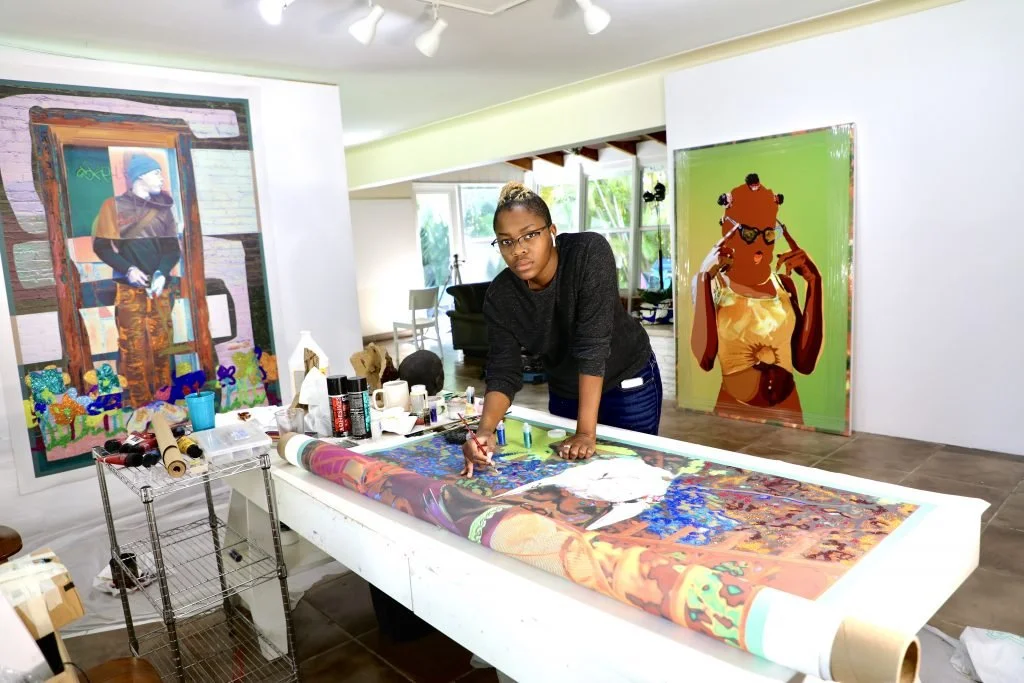
Baltimore-based Artist Amani Lewis graduated from the Maryland Institute College of Art with a BFA in General Fine Arts and Illustration. They enjoy creating imaginative environments that expose the undeniable human connection to nature – despite not being in a physically rural community. The environments Lewis cultivates draw on generations of migration, memory, resilience, loss, and displacement. However, their work draws all these influences together to reveal the healing power of nature.
Exposing the beautiful layers of their hometown, the artist calls for viewers to reconnect to the built environments surrounding them – while listening to and archiving the stories of the inhabitants that make up the city of Baltimore.
“My work exists because these people exist. As the artist, it is important for me to meet the people that make up Baltimore and listen to their stories. My paintings and the resources I garner as an artist work towards shifting the dominant narrative of Baltimore to hold the people and the complexity of our stories at the forefront. I share twenty to fifty percent of the proceeds when a piece is collected with the subject and my collaborators. It is my goal to reimagine the mechanisms used by the media, a tool run by people who do not care to know the depth of our stories, to deepen my subjects perspective of themselves, their power and our relationship to the city. Each piece in the series begins with a photograph of a person. I then distort and saturate their image, modeling an aesthetic akin to a topographical map or heat map. As the artist, I reclaim the power the media wields to tell our stories for us. I manipulate and complexify images of an environment and people whose stories are manipulated and simplified by those who wield economic power over the landscape of the city. By layering paint and textures on top of the prints, my works become complex sites layered with vibrancy, life, heat, energy, growth, healing, safety, magic, and music. The end goal of this series is to gain and slowly begin redistributing the resources needed to shift the landscape of power and view of the city that make up Baltimore.”